Projected Personalities
Connectedness and Loneliness
A journey to create connections
28th July 2026
Before we start ...
If you are in iminent danger, suffering from coersive control, sexual abuse or domestic violence, or are having suicidal thoughts don't hesitate - get help immediately. We can work on feelings of loneliness another time.
Please read and be aware of our disclaimer and copyright statement.
Otherwise, think of this as a guidebook for a journey. The journey is all about you, your feelings, sense of purpose, beliefs, values and hopefully takes you to new places where life is better and you feel more connected with the people around you. Such a journey is challenging at times, but challenging makes for adventure and the joys associated with discovery. Also this guidebook breaks down the journey into simple stages which in and of themselves are easy to complete.
You need the proper equipment to successfully complete a journey, and this one is no different. Three basic tools are required:
- Journalling - as a means of recording your thoughts and ideas,
- Lifeline - the creation of map of your emotional life to date,
- Meditation - to become calm and help identify your true purpose.
Information on these tools is provided on the toolkit page. Additional material on connectedness and loneliness is provided on the resources page.
Start on your meditation and visualisation journey now - just a few minutes a day. That way, when we want to use it you will be ready. Now, let us be on our way.

The start of a grand adventure.
The map of our journey
To help us along on our journey we need a map, and we have just the thing.
The journey is intended to make you feel better about yourself and the world around you, and help alleviate feelings of loneliness by making new connections. The journey consists of a number of steps. It is probably a good idea to do the steps in the order presented below, but it's really up to you. You could do several concurrently, and it's always a good idea to iterate, go back and do activities again in the light of new knowledge you will gain. The high level steps of the journey are:
- A realisation that you might be lonely - there is no shame in this. We all experience some form of loneliness in our lives.
- Understand your own feelings of loneliness - what does it feel like, what triggers those emotions, are they reasonable?
- Start the process of self-connection - look inside yourself, understand your past, realise your own beliefs.
- Build an understanding of your own desires. Study the connections model - what is it you think you're lacking or looking for? Crucially develop a sense of purpose.
- Now you have an idea of what you want, do a stocktake - you may have most of it already in terms of friends and family, just hiding in plain sight.
- Understand your own resources and constraints - your money, mobility, location, to determine what is and is not possible.
- Develop a simple action plan to start forming the connections you want in a way that you can manage.
- Take action, do the plan, be patient, be kind to yourself.
- Review and reflect - what has worked, made you feel better - what was a failure?
- Adjust the plan and go for it - it's only the rest of your life.
Here is the Catch 22 - if you are feeling lonely and are in a vulnerable state, having help and support to work through this process would be great. Chances are, if you're feeling lonely, you don't have that kind of friend available to you. But don't worry - be kind to yourself and take your time, doing what you can. The important thing is to do something, or nothing will get better, possibly only worse. Be patient - don't rush and don't force it. Below is the map of the journey we are going to undertake:
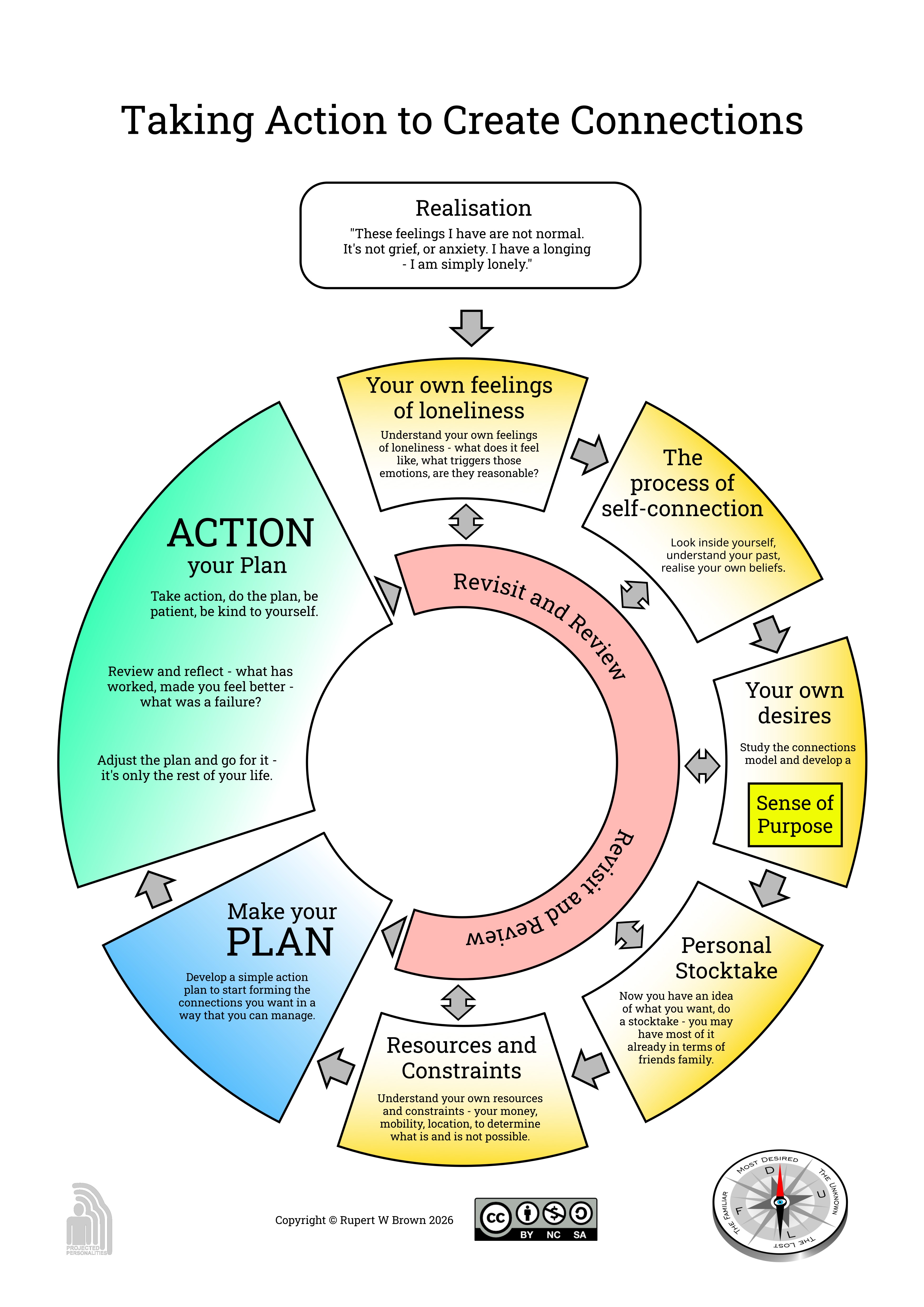
The map - Taking Action to Create Connections.
1. Realisation - how do you know you're lonely?
That is an important question because loneliness can manifest itself in many different ways. If you've just lost an intimate partner it's almost certain and obvious that you will be feeling lonely. Those feelings will also be mixed with grief. But if you're just getting on with your life as best you can and still you sense something is lacking, or you have a longing that you can't really explain, that could be loneliness.
VicHealth (Australia) states that loneliness is commonly understood as an emotional response to the perceived mismatch between the amount of personal contact a person wants and the amount they have. Individual loneliness occurs when a person is missing someone special such as a partner or friend with whom they had a close emotional bond. Social loneliness refers to the absence of a social network made up of a wide group of friends, neighbours and colleagues.
Further, Bruce A Austin at New York's Rochester Institute of Technology created a "loneliness scale". He believes there are three different categories of loneliness:
- intimate loneliness - a yearning for a person you can truly be vulnerable with,
- relational loneliness - a yearning to be part of a social fabric on whom you can rely,
- collective loneliness - a yearning for a group that shares common interests.
Loneliness is dangerous because not only does it make us feel bad, but over the long term it can actually lead to very serious medical conditions including poor cardiovascular health and faster rates of cognitive decline.
That a sense of loneliness - a sense of yearning for something - has physical implications because it actually causes stress. In severe cases stress can put us into that "flight or fight" mode, but because the thing we're stressed about isn't a physical thing (like a tiger), we can't really escape it. We're stuck in this state with a body flooded with stress hormones like cortisol.
If these ideas resonate with you there is a good chance you're feeling lonely. Don't feel embarrassed about it, or that somehow you have failed. Everybody feels this way from time to time. It affects people in different ways and everybody reacts in different ways. The good news is that there are things you can do, and it is important to take action to relieve your feelings of loneliness to safeguard your long term health and well being.
Outcomes
- The conclusion that yes, you do have genuine feelings of loneliness - in which case press on. [If you conclude that your feelings are not loneliness, but something else, you probably don't need to complete this journey, but rather find another, more appropriate path to tread.]
- The first inkling as to what sort of loneliness these feelings relate to.
2. Your own feelings of loneliness.
Every one of the steps in this journey has a rationale. The rationale is reason why the step is useful.
This step is about trying to understand how loneliness makes you feel and crucially when do those feelings appear and what triggers them. If some form of human connection is the answer to reducing your feelings of loneliness, then understanding the type of and when you need that connection is very important.
So this first step asks you be very aware of your feelings and make notes. The notes should be based around three questions:
- What did I feel? Emptiness, longing, anxiety, dull ache, hopelessness - use your words, and try indicate how strong the feeling was on a scale of 1 to 10 (10 being worse).
- When and what was happening at the time? Were you in an argument, just had bad news, was just watching TV, looked at an old photo - describe the scene.
- What was it that set me off? What was it about that situation gave you those feelings? How would a human connection at that point helped?
Essentially what you're doing here is journalling - keeping notes - have a look in the toolkit. You can do that in a notebook you carry with you. You can type details into your phone. You can create voice memos to yourself on your phone. The crucial thing is that you can get access to that information so that you can do a bit of analysis later. That analysis seeks to answer the following:
- Am I getting the same feeling, or are there different types?
- Is there one particular situation that sets me off, or do I react in multiple situations?
- Crucially - how would a human connection at that point have helped? What could they have done to help?
Armed with that information, begin to think about the type(s) of connection you feel you need.
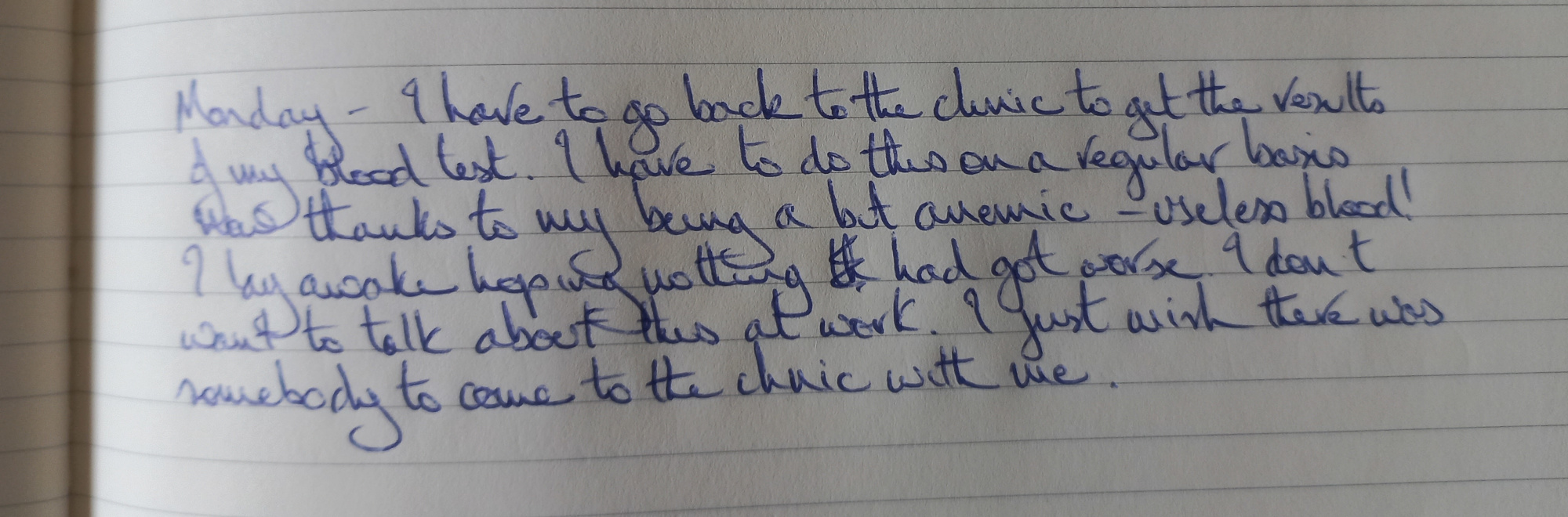
A journal entry - a need for companionship to provide some comfort at an anxious time.
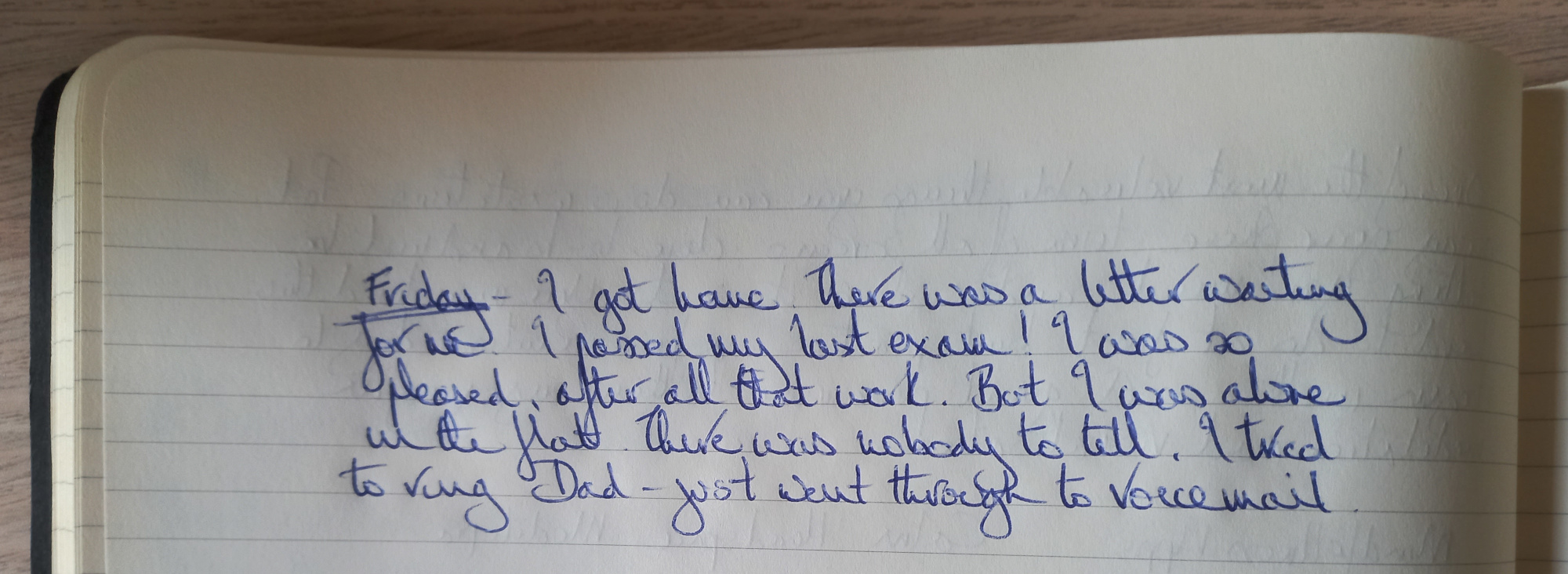
A journal entry - a need for somebody to recognise and share in their success.
But now stop - test yourself - to see if this is one of the many problems caused by social media. Ask yourself this question - are these feelings reasonable? It sounds weird but it is very important. If your view of what your life should look like is based on the "perfect world" of a bunch of influencers on social media, as hard as it sounds it may be completely unrealistic. If you live in a small Australian country town, and you're watching what people are up to in New York, you're bound to feel like you're missing out - and the dreaded fear of missing out (FOMO) is a powerful and negative force. Social media creates social constructs of lives your real life may never be able to match just because of where you are. So think hard about that - don't beat yourself up. Ask yourself if you're longing for something that just isn't available to you right now. Sure, make it a life goal but don't suffer because you don't have it now. But if you know those feelings you have to be real don't ignore them - push on.
Don't let this part of the journey stop you from starting the next step. Go at it for a week or two, keep at it if you feel it's giving you results, but start the next step. You can keep monitoring and journaling your feelings at the same time you do other things.
Outcomes
- Your journal documenting when you experienced feeling of loneliness, what triggered them, and the type of connection that may have helped at that time.
- Your analysis - do these feelings following any kind of pattern - are they the same? And the triggers - is it one situation or many different types?
- Your first thoughts - what type(s) of connection would really help?
3. The process of self-connection.
Self connection is about knowing ourselves deeply and intimately. The rationale behind this activity is so that we can project into the world an authentic version of ourselves. It's only that authentic version that will be able to make long lasting, quality connections with other people. Connections made with a false version of ourselves will almost certainly cause pain and fail in the long run.
If we know ourselves - our beliefs, values, attitudes and how we respond in situations - and behave in a manner that is true to ourselves - then we project into the world an authentic likeness of ourselves. If we don't, then we're projecting some other thing, some avatar. For a connection with another person to be genuine, they should be connecting with our true self, and vice versa. Think of these as important guidelines - when we interact with people we should be honest, respectful, listen more than we talk (never overshare) and reserve judgement - find the truth by asking questions.
That feels like it makes sense, but how do we get to know ourselves ... ?
This stage will focus on the practical steps we can take. There is a lot to self-connection so there are more notes about this on the resources page.
The first step is to draw your own life line.

Alert!
If in the past you have experienced violence, abuse or trauma it may not be a good idea to revisit those experiences through the life line process. If you feel that might be the case then DON'T DO IT, or at least skip over those bad parts of your life - focus instead on the good bits.
A life line is a graph that shows your feelings of happiness or sadness over time. The vertical axis has very happy at the top, neutral in the middle and miserable at the bottom. The horizontal axis is time from the year you first remember to the current year. To help jog your memory about things, at the bottom of the graph note down significant things at the date they happened - like periods of schooling or employment and with who, and where you were living. Then very simply, and without over thinking it, draw your life line indicating how you felt at any given point in time.
Once you have the line, study it. Your subconscious would have told you whether you were happy or not - now it's time to examine that and understand what was going on in your life. Almost certainly your life line will have high and low points. With reference to the example life line below:
- Low point - you really struggled with the final exams at school - that was such a difficult time - Mum getting sick!
- High point - you met Robin. The two of you were so in love, at least it felt like love - ask your self what was it about Robin you liked so much?
- Neutral low point - dull time working in the supermarket stacking shelves. Life was slipping away - ask yourself why did you stay there as long as you did?
- Neutral high point - lots of work at Uni and MKJ - what is your favourite kind of work?
A life line will look something like this:
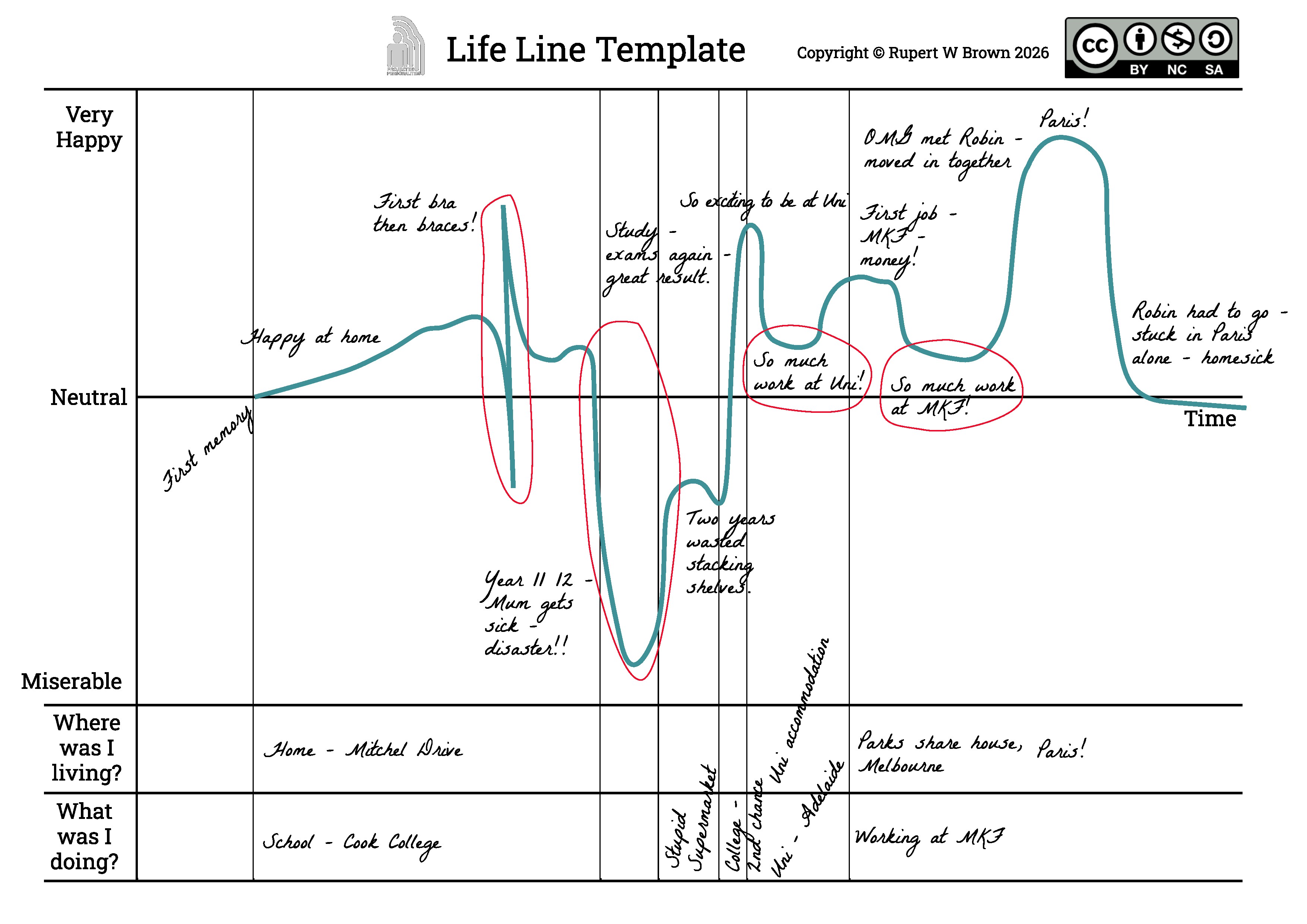
An example of a life line graph.
Jot down some notes in your journal about the high and low points. The value here is to build up a picture of the people and things you really liked and which made you happy: a particular place you liked living, a particular type of person you like to be with, a work activity that makes you feel fulfilled - and those things in the future you really want to avoid.
This is a link to a blank life line template (svg format) you can use.
The next step is to begin to identify your own beliefs and values. As before, this is about getting to know the true version of yourself so that you can project that into the world and make meaningful and genuine connections.
But here is the thing - identifying your own beliefs and values is actually quite hard. They are quite abstract concepts in nature, there seem to be many differing interpretations of what they are and to be honest we are just not used to thinking about ourselves in those terms. To try and make this process simpler, we developed the Beliefs Values Attitude Action (BBVA) model shown below.
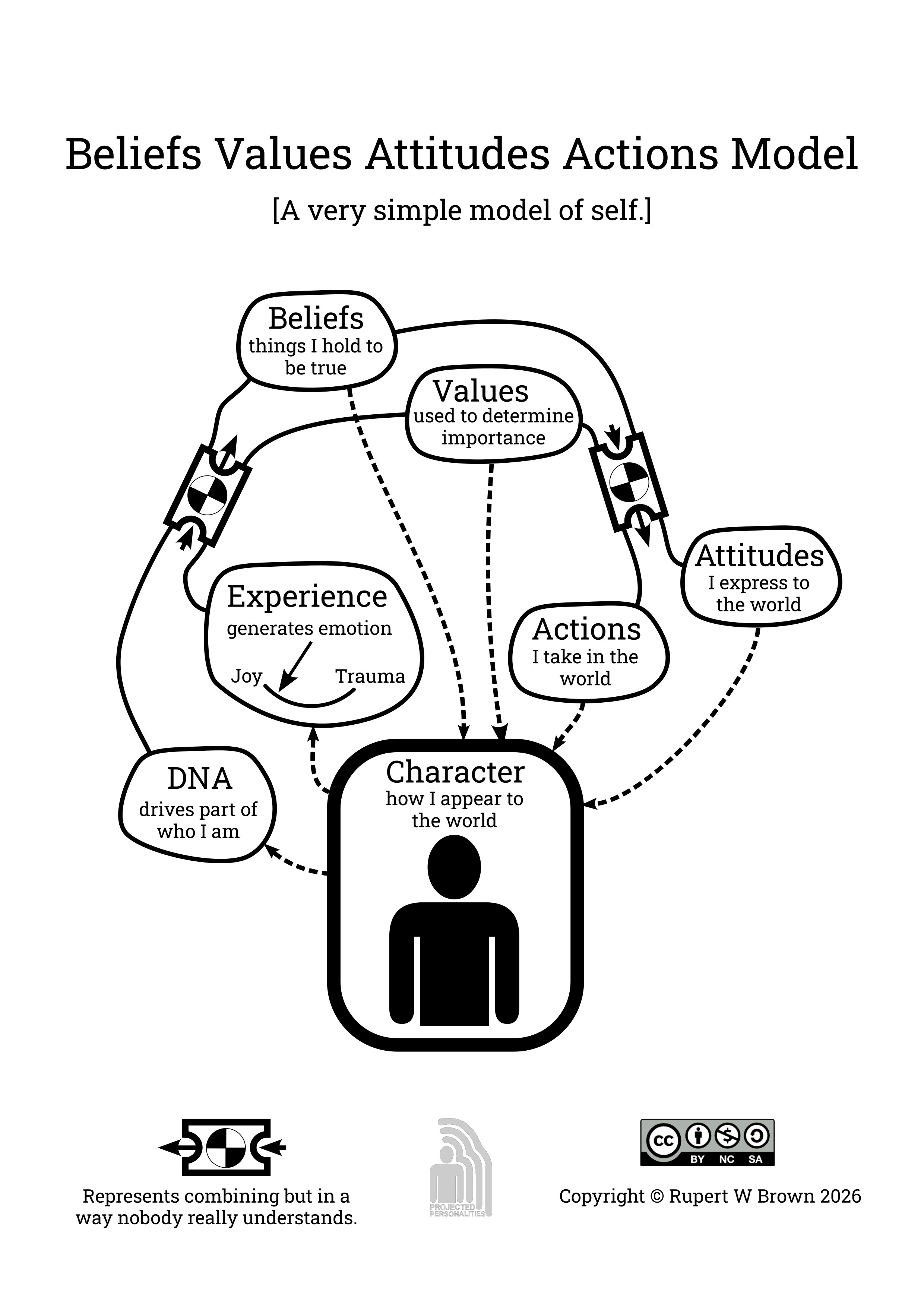
The Beliefs Values Attitude Action (BBVA) model.
We are born with a set of DNA. It comes from our biological parents and is unique to us. It determines our physical characteritics and to some extent our skill set and what we can and can't do. It has a profound effect on who we are.
Then there is our lived experience - the people and places around us when we grew up and the things that happened to us and that we have done over time. There will be times when we experienced joy and trauma and everything in between.
Very simply, a combination of our DNA and lived experience gives us our beliefs, things we hold to be true, and values which signal what is important us.
Beliefs and values combine to give us attitudes about things which ultimately drives the way we respond or take action in the world.
A combination of all these things can be said to determine how the people in the world around us understand our character.
As stated before, this is a simple model, but one that hopefully we can all understand and use to get to know ourselves better.
Now comes the task of trying to identify your beliefs and values. Again, we don't want to overthink this. We really only need our top ten beliefs and values. The first method is to look at a list, work through the list and pick the ten that resonate with you - and write them down in your journal. There are many lists available on the internet. I recommend starting with the two listed below simply because I like the way the information is presented:
- 77 Core Beliefs Examples - HelpfulProfessor.com - here
- 165 Core Values Examples (A to Z) - HelpfulProfessor.com - here
Another powerful way of getting to know yourself is to think of some concrete action you have taken in the real world, and then work backwards from that to derive your beliefs and values. Below is an example of this idea following the simple BVAA model presented above:
Sparkling Wine
Anecdote: When he held parties, a man would buy cheap French sparkling wine for his guests. But for his mother and his wife he would open the best champagne he had. He was quite open about this - it was there for everybody to see on the tables.
Action - he bought cheap champagne for guests, kept the best for his family.
Attitude - my guests, I'm being generous enough giving them something! They should be grateful.
Belief - my family deserves only the best I can provide and I don't care who knows it.
Value - there are different types of people in this world, and some deserve more than others because they're simply better.
There are more anecdote examples in resources.
Record those beliefs and values in your journal, then put it away for a few days. Come back to it and review what you have written. The life line - have you remembered new things from your past that now appear significant? Does that list of beliefs and values still ring true, or do you need to change a few things? You can - it's your own assessment of yourself. You have to be brutally honest with yourself. At the same time you don't have to show it to anybody else unless you want to. If you do have a very close friend or relative that you absolutely trust you could show them and ask the question - do you recognise me in this?
It would be fantastic if all our beliefs were positive statements, but sometimes they may not be. For example you may have a belief that you struggle to finish things, or have problems with committment. That's OK - if you believe it to be true then that is valuable self-knowledge and you can always work to improve.
An analysis task - look at you beliefs and values - have a think about where they position you. Do they hint at a strong social conscious? Do they express an aptitude for action, for environmental concerns, for a desire to succeed? Have a think whether they signal you as a particular type of person and write that in your journal.
Now we come to one of the most rewarding parts of this journey, a detour into a magical place where we look for nothing less than your true sense of purpose. The rationale for this step is very simple - if you follow your sense of purpose there is a good chance you will live your best life. If you meet other people that share something of that sense of purpose, chances are you will form deep and meaningful connections with them. That is why it is worth pursuing this.
If you lack meaning in your life - if you find yourself saying "what's the point?" - that can be a great de-motivator, something that will hold you back from being pro-active about creating connections. If you can't see a clear purpose to your life there will be no direction, and without that it's hard to have goals to work towards, to feel good about.There are three steps that will help us find our true sense of purpose:
- It is highly probable that you already have an inkling as to what it is. When you've had day dreams in the past what were you doing in those dreams? It could be anything - being on the water, working with animals, digging up fossils, advocating for refugees, redefining some aspect of technology. Search your own thoughts and write down a few words that seem appropriate in your journal.
- If you drew a lifeline, get that out and study it again. For each of the main phases in your life, ask yourself the questions "What were my hopes at that point?" "What did I really want to do?" Write the answers to those questions in your journal.
- Then we come to visualisation. This is why I suggested you get practising meditation right from the start. Now try visualisation. Look in the toolkit and try the
Finding purpose script a number of times. Each time write your findings in your journal.
Now the all important analysis part. Look at all those answers in your journal. Look for a common thread or thought. Look for some consistent logic in the answers and write down what that is - let's call it purpose. Leave it aside for a week or two then revisit it and see if it "feels right". If you have a friend you trust ask them whether they see in you your purpose. If your purpose feels right congratulations - you're on your way to a better future. If not don't worry. Give yourself a break then try again.
Now we more ourselves a bit better, it is time to start thinking about what we want and need. What kind of connections would alleviate these feelings of loneliness?
Outcomes
- Your life line graph.
- Your analysis of your life line - the good things and why they were good, and those bad things to be avoided.
- Ten belief statements and ten value statements that you beileve most closely align with you.
- The beginnings of an understanding as to your sense of purpose. Why you're here, why you're important, and what you are going to do.
- You feeling good about yourself - that you know yourself a little better now, how you got to be you and the value you have to share with the world.
4. Your own desires.
The literature talks about a relationship "ideal state" which sees each of us enjoying human connections at different levels of intimacy. The basic model is:
- Self-connection - being in touch with self - being in touch with the worthiness and wholeness of your self. Listening to what your inner voice is saying to you and trying to independently evaluate whether what it says is correct and helpful. As mentioned before, it helps to be self-connected and happy in order to make meaningful connections with other people. Stage 3, which we have just completed, dealt with self-connection.
- Collective connection - defining the society you identify as your own - the wider society in which you live. You understand the traditions, folk-lore, spirit of the people in your community. You can identify with "being Cornish" or "from Melbourne".
- Micro-connections - simple small everyday interactions you have with people who you may not even know. Just like saying hello to somebody in the street. You recognise each other's existance.
- Relational connection - your frienship groups - those groups of people who form the social fabric across which you move. Not intimate necessarily, but more than simple micro-connections.
- Intimate connection - love binds you together - those few people who love you and you love back. Those people who will try and help no matter what the situation. Can be a partner or close family members.
This is summarised in the diagram below:
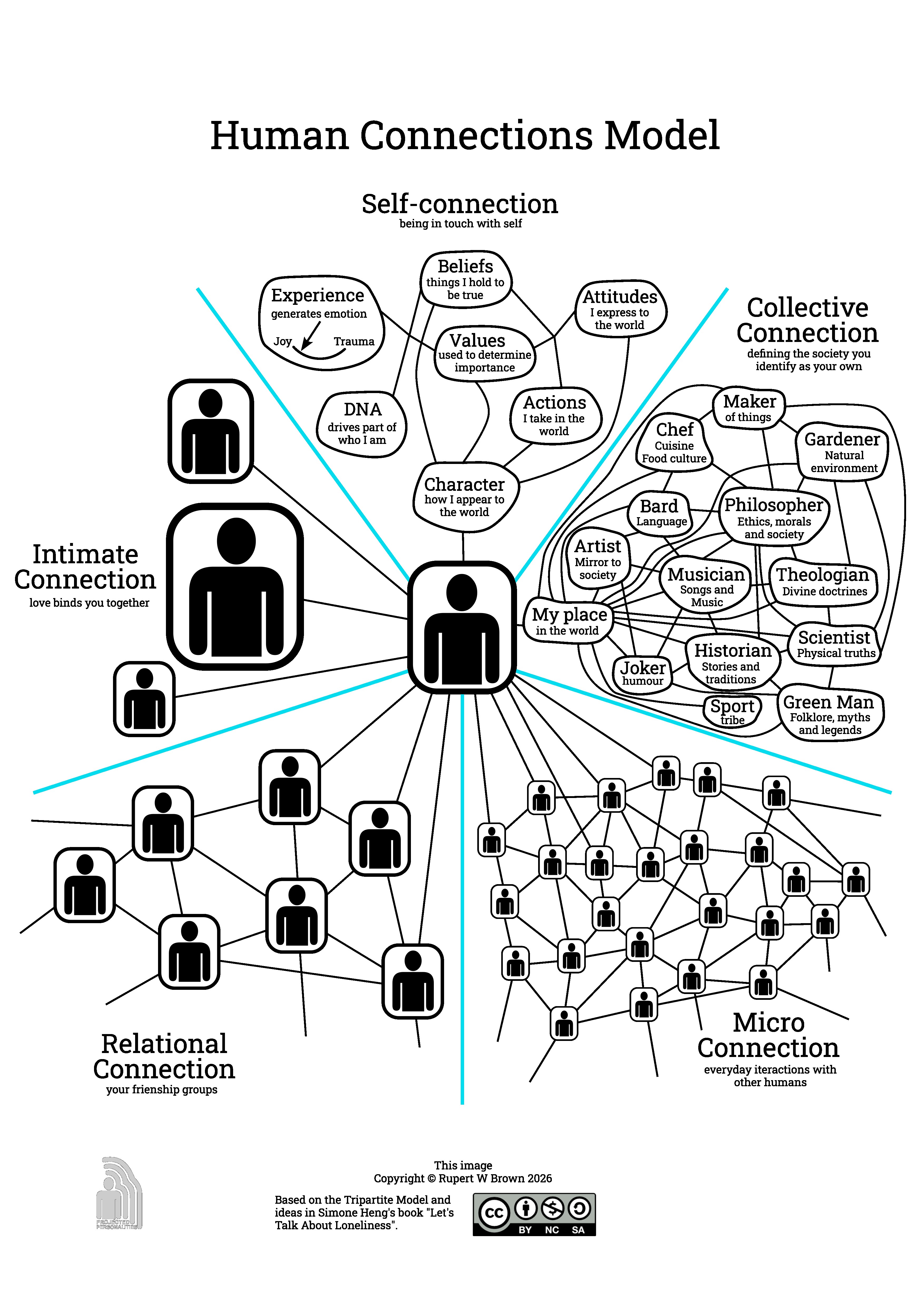
Human Connections Model.
For this part of the journey we need to revisit the journal entries we made back in stage 2 - those notes you kept about your feelings of loneliness and the analysis you did to determine what type(s) of connection you would like. Find those notes and look at them again in the light of all the information you now have about yourself. What messages are you getting?
Because of the very personal nature of your feelings it's not possible at this stage to give you specific help, but read the following and hopefully it will help you to decide what you need. We won't cover self-connection - we've just spent time working through that one.
Do your feelings of loneliness also come with a sense of homesickness? This is a very common scenario for so many people who have to move for work or any number of other reasons. They find themselves in a new city or even a new city in a new country. Suddenly nothing is familiar. The food is different, the language is strange, the sense of humour opaque, and nobody really seems to get them. Their collective connection has been broken, their social fabric torn. Are you looking for collective connection?
According to studies done by the Jo Cox Foundation and Age UK in the UK, as many as 200,000 older people will go for a whole month without talking to anybody. They feel invisible. We all need to be seen. It's important that another person acknowledges we are here in the world, even if for the most fleeting of moments. This is the importance of micro-connections, small interactions with people that keep us rooted in this world as a living human being. How is it possible that people can go for so long without talking to another person? One of the simple answers is technology. From ordering on-line, to the supermarket self-service checkout, technology has the ability to rob us of basic human interactions. Are you looking for more small interactions with people - with anybody!
You've been working really hard, putting in long hours and feeling under pressure. The deadline was met, the work delivered and now its Saturday morning. You're lying in bed with no real need nor desire to get out of it. You're wondering what you're going to do with the weekend. You'd like to have dinner in the pub but your friend Charles has gone on a mini-break with his latest girlfriend. You think hard about who else you could call. There are people from work but you just spent all week with them - you don't need their company over the weekend too. Your brother is miles away on some business trip. Seriously, are you going to spend the weekend alone? Are you thinking you need a bigger friendship group?
You know you would feel so much better if there was somebody who would give you a hug every now then. Somebody whose hand you could hold and talk about your hopes and fears without feeling embarrassed. Somebody who knows you better than you know yourself and who unselfishly acts to make your life a little better. Somebody you could make plans with. Society tells us that there is somebody special for everybody, you just have to find them. That may or may not be true. What is true is that from time to time we all crave intimacy and, if not fulfilled, that feeling hurts.
Outcomes
Having done that thinking, building on the work from section 2, write down in your journal what kind of connections you think you would really like. Use your own words.
Congratulations - you've just set your goals, your desired outcomes of this journey. They may be hard and difficult to achieve, but now you know what they are, and that in its own right is a great comfort. If nothing else you can use your visualisation practice to experience in your own mind achieving those outcomes. Use that practice to fine tune your goals and maybe seek out paths to success.
5. Personal stocktake.
One of the aims of this journey is to get you the connections you want as fast as possible. Now that we know much more about ourselves and we have real knowledge about what we want, it's time to do a personal stocktake. It can be easier to connect with somebody we are already familiar with than make a totally new connection. It might just be that much of what we want we already have - we just can't see it or we've forgotten about it or something from the past is blocking us.
A personal stocktake is the process of capturing your own network from the past and the present.
Alert!
We are about to look back into our past. As before, if in the past you have experienced violence, abuse or trauma it may not be a good idea to revisit those experiences. If you feel that might be the case then DON'T DO IT, or at least skip over those parts of your life - focus instead on the good bits.
This personal stocktake covers three areas:
- The creation and analysis of your family tree,
- Another look at that lifeline, this time focussing on the people who have been a part of your life,
- Your current social circles, no matter how small or fleeting those connections may be.
The personal stocktake idea is summarised in the diagram below:
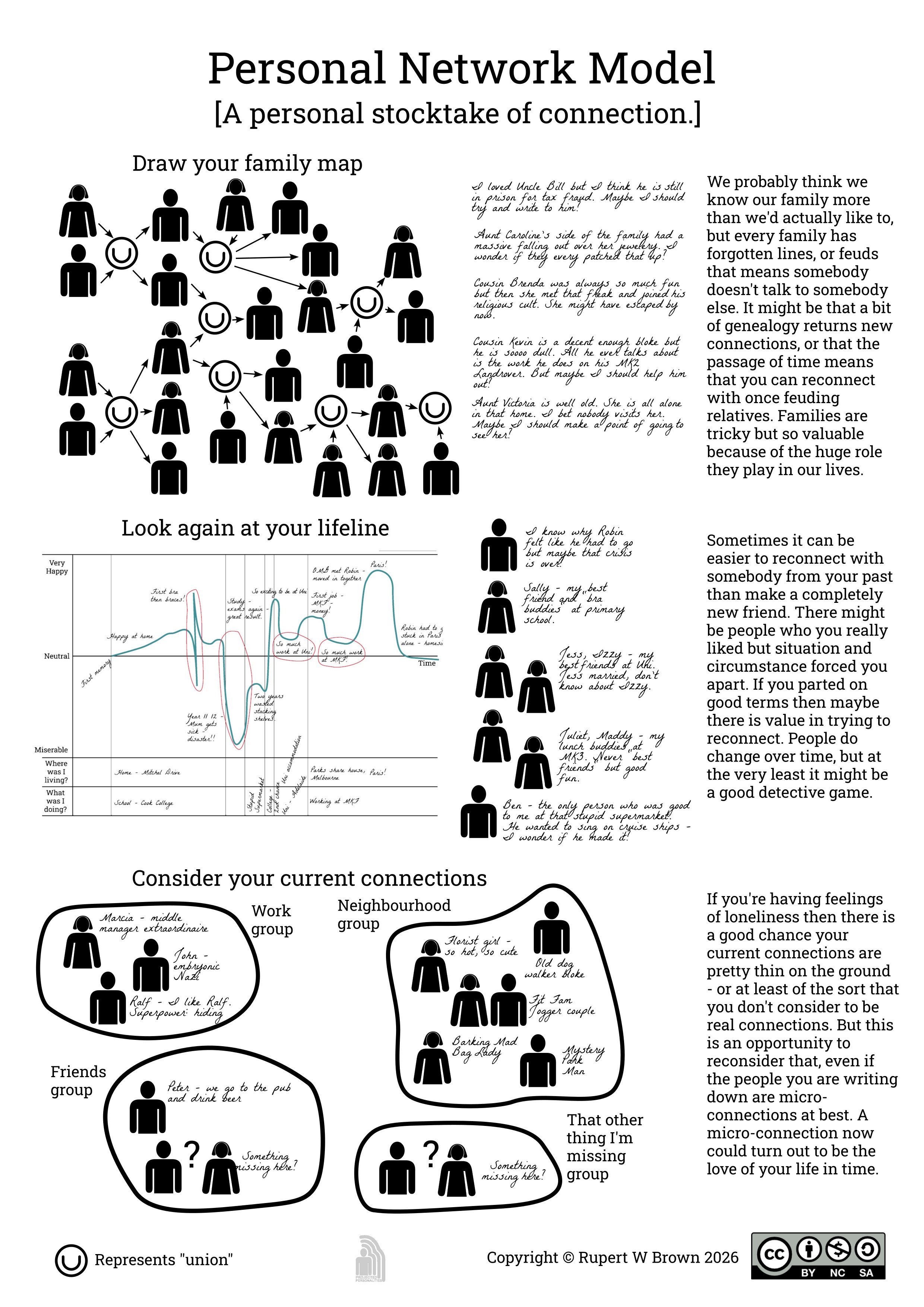
Personal Network Model.
Family tree
We probably think we know our family more than we'd actually like to, but every family has forgotten lines, or feuds that means somebody doesn't talk to somebody else. It might be that a bit of genealogy returns new connections, or that the passage of time means that you can reconnect with once feuding relatives. Families are tricky but so valuable because of the huge role they play in our lives.
This activity can be a cursory back of an envelope five minute exercise in the cafe, to a months long genealogy project involved detailed research using hundreds of physical and on-line resources. It's really up to you what you do. The aim is to quickly identify living relatives with whom you had some kind of connection. The question is - would reaching out and getting in touch again be mutually beneficial? What do you think?
A lot of people find genealogy a fascinating hobby and there are societies and clubs dedicated to the subject all over the world. It might be that researching your family history with somebody is a lot of fun.
Lifeline revisit
As mentioned above, sometimes it can be easier to reconnect with somebody from your past than make a completely new friend. There might be people who you really liked but situation and circumstance forced you apart. If you parted on good terms then maybe there is value in trying to reconnect. People do change over time, but at the very least it might be a good detective game.
Previously when we were analysing our life line, the emphasis was on good and bad feelings and the situations that gave rise to those feelings. This time the emphasis should be on the people. Times were bad but you got through it together - with who? Those were great memories, in part because he/she/they were there - who? In your journal gather as many of those whos as you can think of, then do another bit of analysis, with the emphasis being on answering, for yourself, would I like to see them again? Would they want to see me? At this stage don't overthink it and don't be too hard on yourself. It's too easy to find reasons to dismiss everybody on your list. At least allow yourself one or two people to reconnect with.
Current connections
If you're having feelings of loneliness then there is a good chance your current connections are pretty thin on the ground - or at least of the sort that you don't consider to be real connections. But this is an opportunity to reconsider that, even if the people you are writing down are micro-connections at best. A micro-connection now could turn out to be the love of your life in time.
How can we develop a micro-connection into something more? Through simple engagement and time spent together. Acknowledge the presence of the person with a simple hello, then build on that with a simple question - "how you travelling" - or statement - "what were the bin men up to this morning?" Even though you are not in Ground Hog day (even if it feels like it) play that game Phil (Bill Murray) worked so well - one simple question a day which he used to effect on Nancy. You never know what you will find. The Barking Mad Bag Lady may be the way she is because she had to flee Soviet persecution and her story is pure John Le Carre.
Outcomes
A simple list of names - names of people along with a description of the type of connection you have with them and why getting in touch might be a good idea. See the examples below.
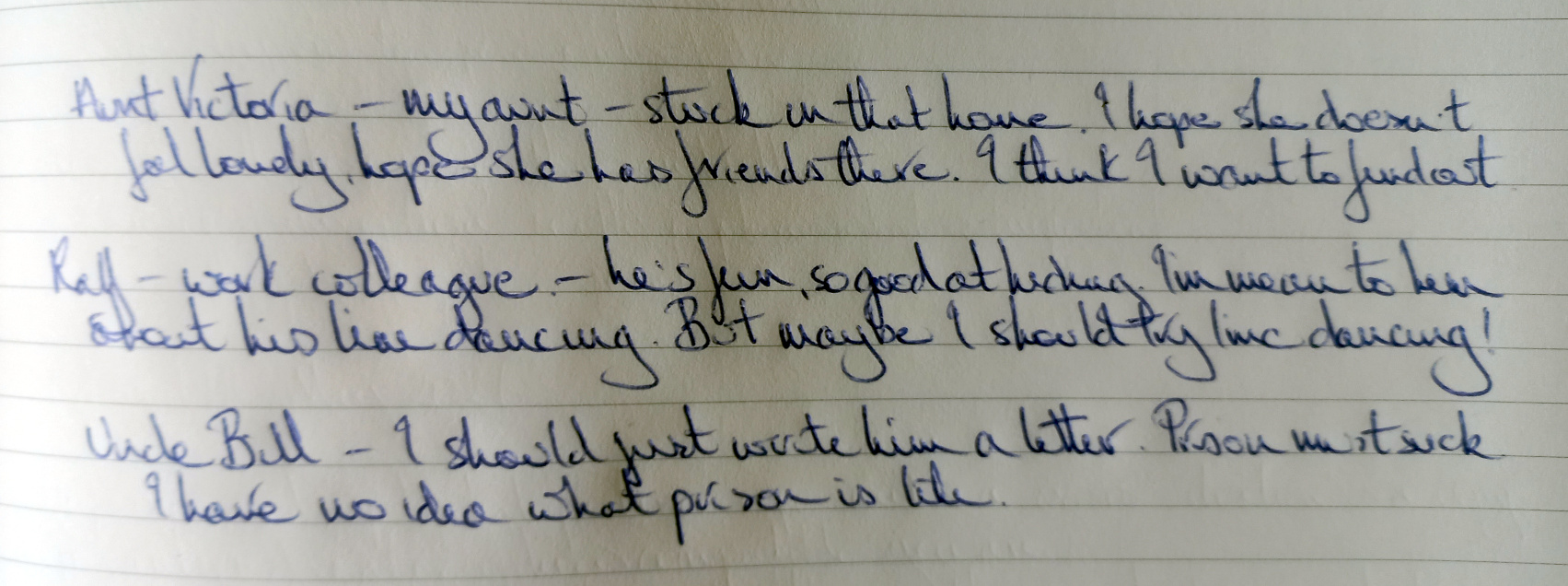
My list of people I already know.
6. Resources and constraints.
Even rich people with significant resources can and do suffer from feelings of loneliness and isolation. Wealth brings with it its own set of problems. But having access to resources can solve many practical problems that the majority of us just have to try and deal with. Your resources and constraints will have an impact on what you can do to create new connections with people, so it's good to understand what they are.
On this journey there are two key resources that we must consider:
- Time - we have to have time, at appropriate times, to spend with other people to develop those true connections, and
- Money - not for its own sake but so we can afford to travel to meet people, pay for things like club memberships and certain social events like having a meal out or a weekend away.
Constraints may include:
- Your own state of mind - how open do you feel to getting out and about and meeting people? You might be longing for it but at the same time the thought could be scary.
- Trouble at home - as was mentioned right at the beginning of this journey, if you are in a situation where somebody is exercising coersive control over you and your feelings of loneliness are because somebody is restricting what you can do, then please do what you can to seek help.
- Your commitments - you may be working two jobs or be a full time carer, or have other responsibilities that limit what you can do and when.
- A disability - that restricts what you can do and when. You may have to rely on outside support.
You want to know how much money you can spend developing these contacts, and when you can commit time to it. To answer that you need two things:
- A personal budget - you may have one already and be very aware of your financial situation, in which case all good, no need to do further work. If you haven't got a budget then it is a good idea to develop one. There are many resources on-line including Moneysmart and Budgeting from the Australian government. The Barefoot Investor is highly recommended as a general guide to manage your money. The Barefoot Investor book has sold millions of copies so it can be found for a few dollars in charity and opportunity shops.
- A personal schedule - not that it has to be perfectly accurate, but something that provides enough detail so you can see how much and when you have time available to do things. When you're thinking about a personal schedule don't cram it full. You need blocks of time "to do nothing", and practice your meditation and visualisation, do a creative activity and just potter about.
Some people will be in a situation where money isn't a problem. Some people will be either eating or paying a fuel bill, never both. Some people will feel like they have plenty of time and some will feel like they haven't got the time to fart, let alone do anything meaningful. Whatever the situation, there will be something you can do - it comes down to planning which is what we do next.
Outcomes
- A good understanding as to just how much money you can spend engaging in activities to help you develop new connections with people.
- How much, and when you can commit time to those activities.
7. Make your Plan.
I have a cunning plan - Baldrick
In that case what could possibly go wrong?
Here's the thing, even if your plan is as cunning as a fox who's just been appointed Professor of Cunning at Oxford University (to quote Lord Blackadder) and it still goes horribly wrong - don't worry, but more importantly never let fear of failure stop you from trying. You are better than that.
This is the stage of our journey where we bring together all of the outcomes from the previous stages. This is where all of that thinking and analysing comes together.
The outcomes of stage 3 gave you an understanding of your sense of purpose, beliefs and values. Hopefully, whatever you decide to do in your plan aligns with that understanding.
The outcomes of stage 4 gave you an understanding of the kind of connections you would like to make. Your plan should be designed to help you make those connections.
The outcomes of stage 5 gave you the names of a few people that you already know and who you think it might be worth trying to reconnect with. These people represent the easy start to your plan.
The kind of connections ...
This is all about seeking out your tribe.
If you're in a new country, food, wine and music from the old country can be a great source of comfort. Search through the restaurants in your area to see if there is anything that reminds you of home.
Similarly joining a group to support a national sports team can be a way of meeting people with similar backgrounds and a lot of fun.
If you're lucky there may be a relevant cultural community centre nearby.
Use the ideas in the paragraph below to see just what is available.
Try these simple things.
Where possible don't use a supermarket but rather find and engage with a local butcher, greengrocer, baker and bottle shop/wine merchant. Talk to them about what you want to cook and drink with it.
If you must use a supermarket, never use the self-service checkout. Wait in line at the checkout where there is a real person. Ask the person behind you in the queue what they are going to do with a whole head of celery/20 kg of carrots/beef cheeks (whatever!). Smile at the checkout person.
Only order stuff on-line if you really can't get it from a physical store - otherwise go to the physical store.
Where possible don't buy cheap stuff made in China. Go to the charity or opportunity shop and see if you can find it second hand, or if there is a local artisan who could make it for you.
Find out where your local library is and visit it on a regular basis. Borrow something, anything, every time you visit. Say hello to the librarian.
Stop doomscrolling, put your phone down and read that weird book you got from the library.
Find your local third spaces and use them on a regular basis.
This is the thing - so much of our technology is touted as beneficial because it is designed to save you time. Order everything - one click! But saving your time to do what? Doomscroll, watch cat videos? Talking to a greengrocer about celeriac is not a waste of time, it is living, engaging with somebody, acknowledging each other's presence. And celeriac is weird but can be really tasty.
This is all about seeking out groups of people who ideally share your sense of purpose, beliefs and values, and enables you to spend time together doing something you really enjoy - and in the process develop new connections.
The number and variety of groups you can access will depend to an extent on where you live. It's a tough truth that if you live in a small country town, the only active groups may be the Country Fire Authority and the local football and netball club. You might feel like you know most of the people involved already, and sport isn't really your thing anyway. But lets come at this a different way. A football club is all about playing football but there is so much more to it than that. Think on this:
- The players play football,
- There is an administration component that keeps the club organisation running,
- There is scope for a football correspondent to write up the games for a local newspaper,
- Somebody would need to take pictures of the matches to go with the story,
- Producing reels for social media is important to attract new players and sponsors,
- Football clubs always need catering,
- Football can be rough, games need first aid qualified people on stand by,
- Clubs always need money - somebody to garner sponsorship money is invaluable,
- And clubs thrive on people just turning up to games and being raucous.
I hope you don't find that too contrived - I hope it shows that even if you're not interested in football, a club offers other opportunities that may bring you into contact with people with whom you can go on to form connections.
If you live in a big city like Melbourne the range of opportunities, in terms of clubs, groups and societies, is only limited by your imagination.
There are two aspects to this:
Now we have to go there and talk about sex which is a very complex and sometimes sensitive subject. There is a real difference between forming an intimate connection with somebody and shagging. They are not the same thing at all.
If you're really interested in shagging and just getting your numbers up then go for it. There are any number of websites out there that seem to be quite successful at letting you arrange and consumate a successful shag. You know though that on-line dating has it's dangers. This section in Resources summarises some of those dangers.
But the anecdotal evidence is that if you want more than that, then don't shag straight away. If you're both interested in more than shagging, then conversation will come first and the sex at some point in the future when it feels right.
On-line dating sites have different requirements when it comes to setting up your profile. Some want you to complete very detailed (and intimate) questionnaires, while others let you tick a few boxes and write a couple of sentences about yourself and what you're looking for. When it comes to creating your profile consider using some of the language from your sense of purpose, beliefs and values - you don't have to, but it makes sense if you want to project a true version of yourself to the world.
Again the anecdotal evidence is that when people are searching for an intimate partner, on-line services provide a relatively quick and easy route to get access to thousands of potential mates. But don't forget about just meeting somebody in real life. It might be that all you have to do is work on your relational connections and that special somebody will emerge quite naturally. It is easy to feel under pressure to find a mate, and when things don't work out in the timeframe you'd like it can be depressing. Work on building those relational connections, have fun visualising your first meeting with your special somebody and the Earth will respond in some form.
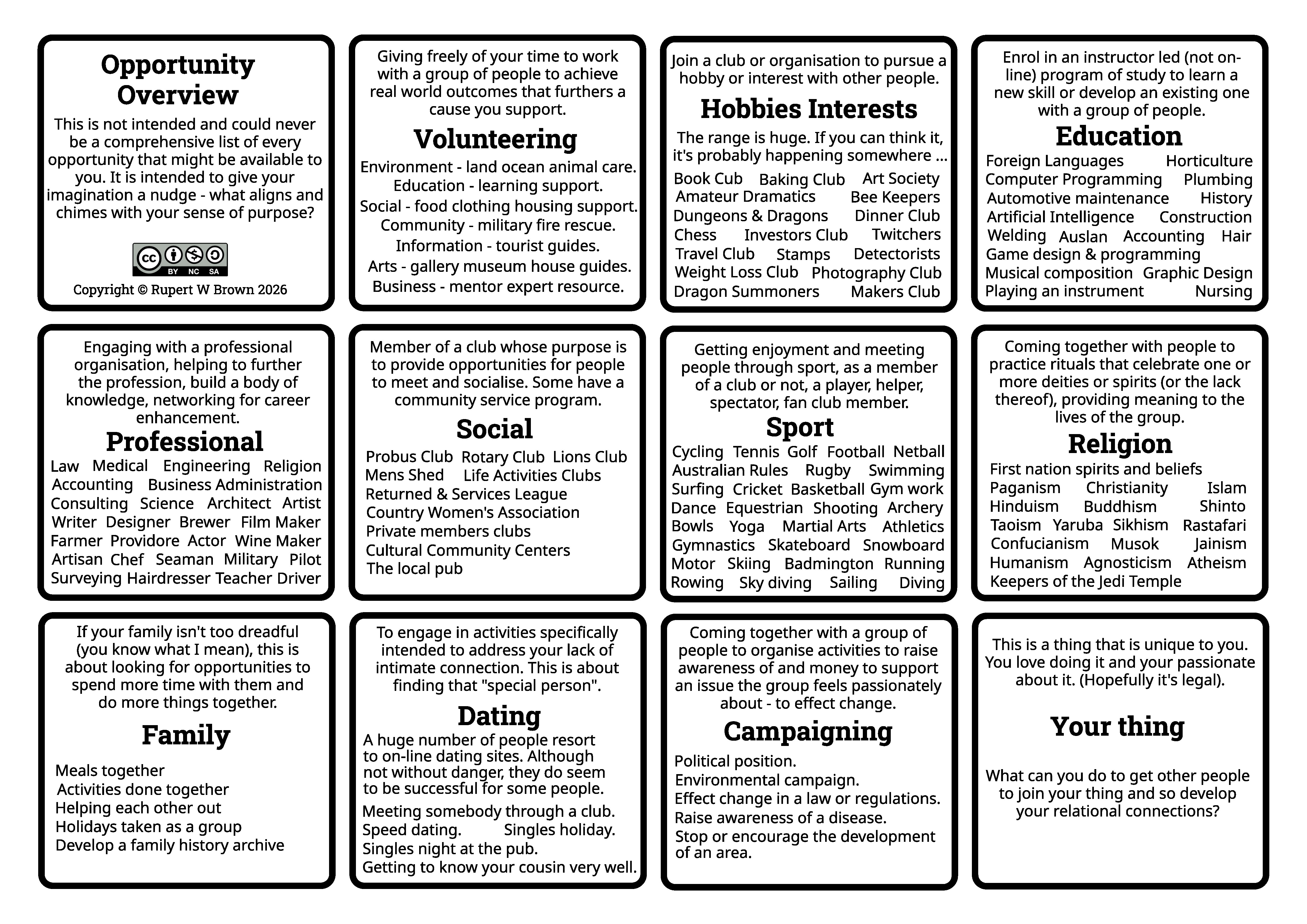
Opportunity overview
Have a look at the opportunity overview diagram below. You can move around and zoom in and out in the window below or simply download the whole thing as a pdf.
The opportunity overview is not intended to be and could never be a comprehensive list of every opportunity that might be available to you. It is intended to give your imagination a nudge - what aligns and chimes with your sense of purpose? Study it - see what stirs within.
Discovery
All of the below are ways to discover local groups, societies and organisations. As with everything on the internet, approach what they tell with caution and do your own independent checking to ensure you are not heading into a situation that puts you in danger.
Ways of discovering include:
- Ask family and people you know,
- Just do a regular internet search,
- humanitix - for events
- Meetup - as a place where groups advertise meetings
- Facebook Groups - same idea
- Reddit communities (e.g. local city subreddits)
- Odd Circles
- Discord
- or walk to the library, community hall or local general store and see what is on their community notice board.
The workplace
In theory the workplace should be a great place to make connections, make friends. You're usually with other people a lot of the time, working on some common goal. The reality is that some workplaces are brilliant and some are definitely not. The biggest single factor that seems to determine whether a workplace is good or not is the management team. The saying goes people very rarely leave a bad company, they leave a bad manager.
That said do look to your workplace as a place to make connections. Being in a workplace is a powerful shared experience that gives you something in common right from the word go. Spending time together, which is a necessary part of making quality connections, is also something that could happen at work.
The COVID 19 pandemic resulted in many of us working remotely, at home or in some other space. For many people that was a liberating experience because of the flexibility it gave them which it turn improved the structure of their life. The downside is that they were also removed from real life contact with coworkers. Working from home is at the same time liberating and isolating. By now you will probably know what best suits you, but if you work remotely and are feeling lonely maybe one or two days a week in an office isn't such a bad move.
Finally, the plan
You've looked at the opportunity overview and decided on two or three things that resonate with your sense of purpose. You've done the discovery to see what is available is your area. Then, unfortunately, you have to apply on top of that your understanding of your own resources. Basically it comes down to what is available, that I can do given my time, personal and financial constraints? You may have to iterate around several options to get to something that is reasonable for you - and it may not be your ideal choice at this stage. The point is something is better than nothing because nothing is set in stone. Your journey is about discovering what works for you, and making adjustments to ensure things get better over time. Now is the time to write this all down.
Note: if you've looked at the opportunity overview and found something which really appeals to you, but doesn't seem remotely connected to what you thought was your sense of purpose, well that is fine. Just think on it a bit more - maybe you haven't expressed your sense of purpose in quite the right way. Maybe it is more nuanced than you imagined. This is your life - you can change whatever you like.
Use this form (download pdf) to create your plan. To give you a sense of how this works, below is the plan of Charlie Sharpe - as an example.
The plan you write is yours - you can include whatever you like - but it's only going to be of any use if it helps you to get out and make real people connections. Make sure it does.
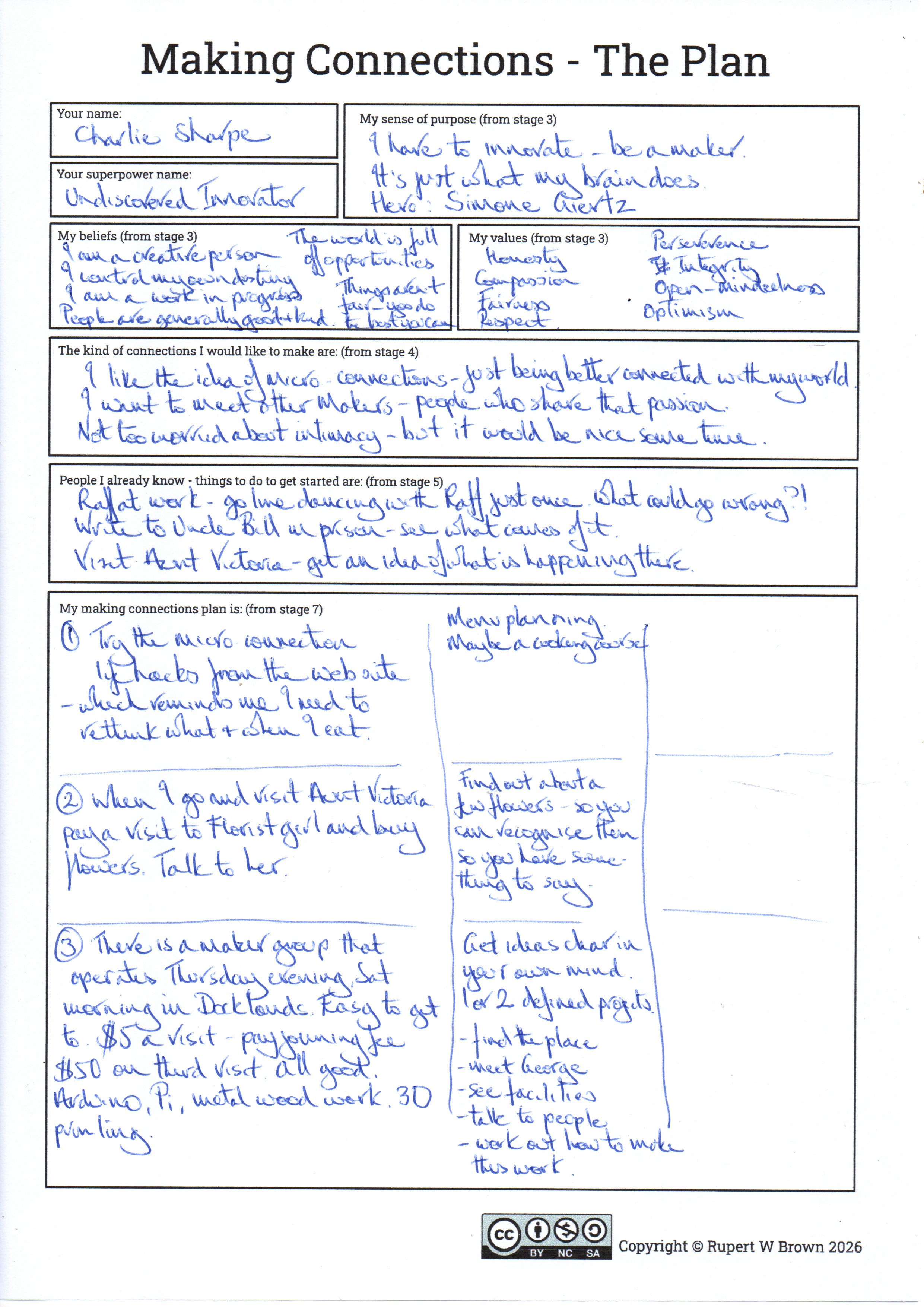
Charlie Sharpe's making connections plan.
Charlie's sense of purpose is to be an innovator, a maker. Charlie's hero is Simone Giertz who is a very funny innovator and designer and who has produced some brilliant YouTube content. You don't have to have a hero - but it might help if you want to see yourself in a certain way. Charlie has taken the superpower name of Undiscovered Innovator, possibly hinting at great things to come. You are free to describe yourself anyway you want, from Keeper of the Deep to The One True Lord of Sushi or not at all. Whatever feels right and helps you.
Charlie has written down the results of all the good work done in stages 3, 4 and 5 of the journey.
The space for stage 7 is used in a particular way and is intended to be flexible to accommodate your plan - but the idea is that:
- Every plan activity gets its own row, and each row is divided into columns,
- The first column is a description of the plan activity - what you are actually going to do,
- The second column contains details of any work you might have to do to prepare for the activity and could contain a visualisation script to help you achieve the best outcome. Charlie has the beginnings of a visualisation script for his Makers group. Thinking about micro-connections has also made Charlie wonder about his diet,
- The last column at the moment is left blank. This is for your assessment as to how well things went which we will use in stage 9 - Revisit and Review.
Charlie has also spotted an opportunity to talk to Florist girl by buying flowers when visiting Aunt Victoria - good thinking.

Since Florist girl (Leah) starting working in the flower shop, the local interest in flower arranging and Ikebana has surged 472% - for no obvious reason at all.
Outcomes
Congratulations - you have a cunning plan! Great work. Now we just need to put it into action.
8. Action your Plan.
This stage is about one thing - get out there and turn your plan into action!
Two considerations before you are unleashed into an unsuspecting world:
- Be confident of your success. You've worked hard to develop your plan. This is right for you. Use the visualisation technique to rehearse your first meetings with people. Be comfortable that you know how well things will go.
- Take an impartial look at yourself. If you have more metalwork in your face than the Sydney harbour bridge has rivets - or your T-shirt has more expletives on it than a Sex Pistols record - then congratulations on being comfortable with your life choices, but maybe just for the first meeting you should try and tone it down a bit. You want people to focus on you the person, not you the walking abstract art installation.
When you are in the moment meeting a new person:
- Look at them - make sure they know you see them,
- Listen to them more than talk,
- Use active listening, understand what they are saying and ask a question if you don't,
- When you come to speak say what you need to say but never overshare,
- Never get out your phone and start doomscrolling.
OK, enough words - get to it and good luck, we're all counting on you.
9. Revisit and Review.
Well, how did that go? Are you flying high, or a shattered wreck? Whatever the outcome, it is very important that you take stock and assess the good and bad of the experience. Only then can you make adjustments to your plan. Lets see how Charlie went.
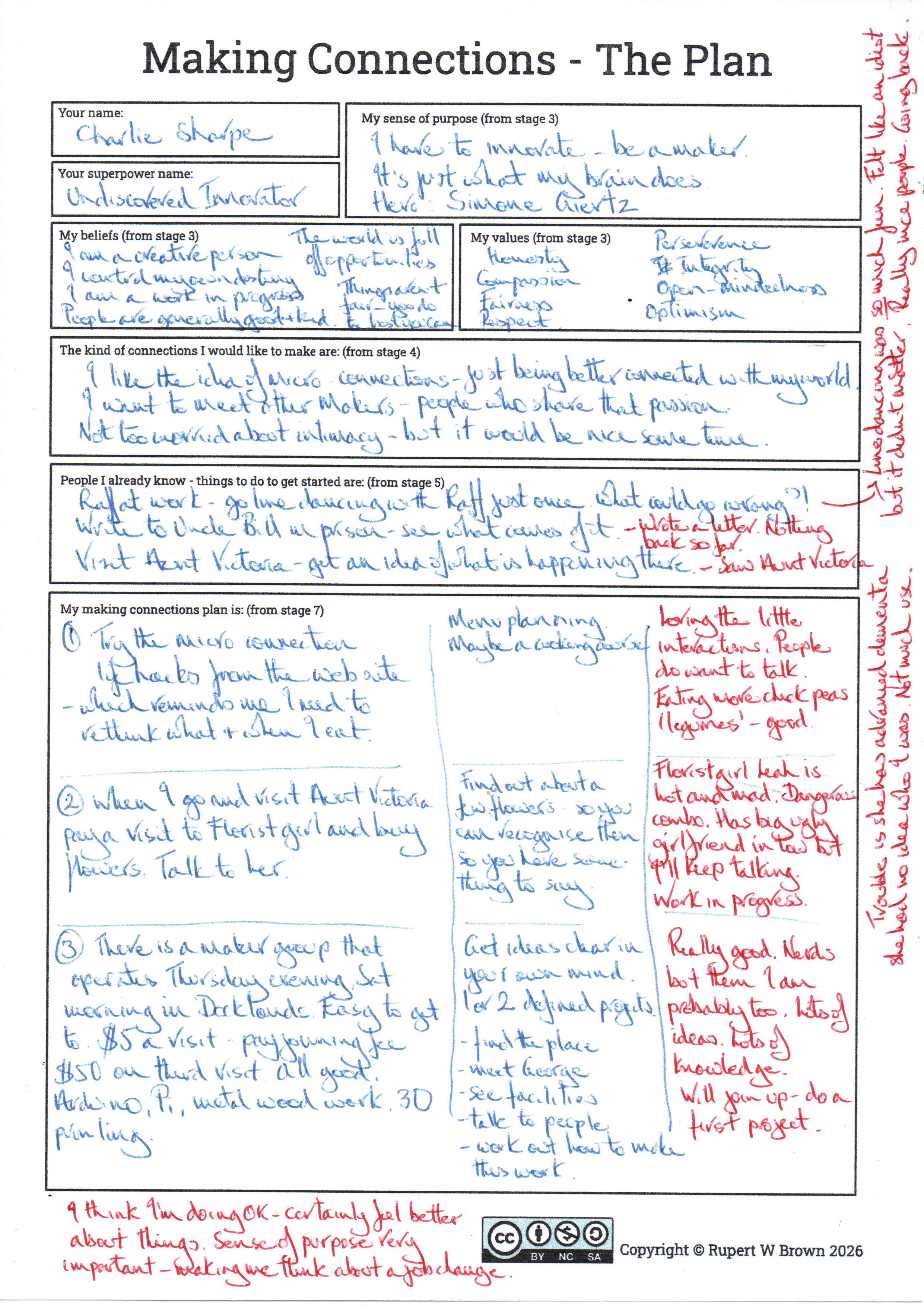
Charlie Sharpe's assessment of the making connections plan.
On the whole Charlie's plan was a success. No response from Uncle Bill but then it might be difficult for prisoners to send letters. Aunt Victoria has dementia so Charlie being there might not make any real difference. Raff's line dancing was obviously a hit. Charlie is obviously quite taken with that scene.
Florist girl Leah was obviously more then Charlie bargained for. It will be interesting to see how that pans out. The micro-connection work and the Makers Club both seem to be successful. Charlie's own assessment seems positive. Things are getting better.
That is the heart of this journey. You try something, you see how you feel, you adjust, you move forward - always to a better future.

Now Charlie's assessment of Leah was a little unkind, especially when you understand what she has to deal with at the back of the shop. Be aware that when you meet people for the first time you really don't know what they're going through and having to deal with. Suspend judgement till you know better.
10. And finally ...
Congratulations on getting to this point. It may look like the end but for you it's simply the end of the beginning. You have the rest of your life ahead of you, and hopefully it will be a grand adventure.
One last piece of advice - having good connections with people enriches your life. Technology can't do that. Being in a certain place doesn't do it. It's always about being with other people, doing things together and sharing stories.
May your path be bright and clear.

A grand adventure awaits.